

5 min read
How to exchange Steam gems, and what you can get
What exchanging gems actually means inside Steam, what they can and cannot be swapped for, and the three ways to turn a pile of gems into something else.
There is no gem exchange inside Steam
This is the thing worth knowing first, because most people searching for one are looking for a screen that does not exist. Valve never built a place where you swap gems for keys, for cash, or for another player's items at a published rate.
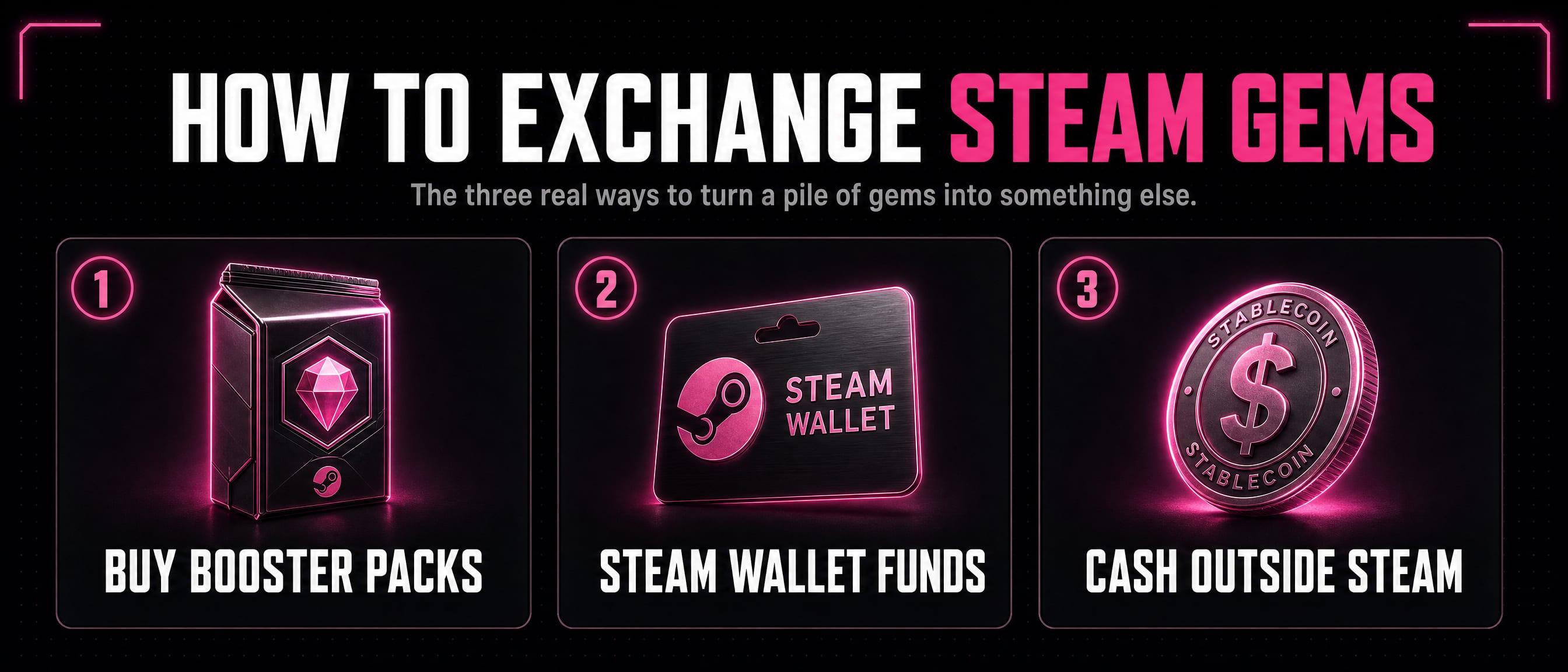
What exists instead is a set of one-way doors, each turning gems into a different thing, plus the ordinary Community Market where gems can be sold like any other item. Exchanging gems means picking one of those doors.
So when a site advertises a gem exchange, what it means is that it will buy your gems from you, or sell you some. That is a trade with a counterparty, not a Valve feature.
Door one: gems into booster packs
This is the only exchange Valve itself offers. A fixed number of gems buys a booster pack for a game you own cards in, and the pack contains a few of that game's trading cards.
It is worth doing when you are levelling and need cards for a game you are short on, because it converts an idle pile into badge progress directly. It is worth avoiding if the cards inside are cheap ones, since you may be spending more in gems than the cards fetch.
Check what that game's cards actually sell for before opening a pack. The gem cost is the same for every game; the value of what comes out is not.
Door two: gems into Steam Wallet funds
Bag your gems into Sacks of Gems, one thousand per sack, and list the sacks on the Community Market. This is the closest thing to a public exchange rate for gems, and it is a fair reference for what they are worth on any given day.
What you get back is Steam Wallet funds, minus the market's fee. Those funds buy games and items, and that is the end of what they do. There is no withdrawal, no conversion, and no route out of Steam.
So this door is right if you were going to spend the money in Steam anyway, and wrong if you wanted money.
Door three: gems into money
Selling the sacks to a buyer who settles outside Steam is the only way the value leaves the platform. You send the sacks as an ordinary Steam trade offer and are paid in something spendable, which for us means USDT or USDC to your own wallet.
The rate will be below the market price, and that is not a trick: the buyer carries the gems until somebody wants them, covers the fees at both ends, and takes the loss on trades that go wrong. What matters is how wide that gap is, and whether the same rate is offered to everybody.
It also runs the other way. If you want gems rather than money, buying a large quantity outright is far quicker than gemming years of backgrounds one at a time.
What you cannot exchange gems for
There is no direct gem-to-key swap in Steam. Anyone offering one is doing two separate trades and pricing both, which is fine as long as you can see each price rather than only the combined one.
Gems cannot be turned back into the cards, backgrounds or emoticons they were made from. Gemming an item is final, so check the market price of anything unusual before it goes into the pile.
And Valve does not convert gems to cash, at any rate, ever. Every route to money runs through another person.
Working out whether a rate is fair
Get everything into the same unit first. Gems are quoted per thousand almost everywhere, because a single gem is a fraction of a cent, so check which unit a rate is using before comparing two of them.
Then compare like with like. A market price paid in Wallet funds and a desk price paid in stablecoin are not the same number even when they read the same, because one of them can be spent anywhere and the other cannot.
Sources
Exchange your gems for crypto
A flat price per thousand, paid to your own wallet rather than into Steam.