

5 min read
What Steam gems are worth, and how to sell them
Where gems come from, why they are priced per thousand, what a Sack of Gems is for, and how to turn a pile of them into money rather than Steam Wallet funds.
Where gems come from
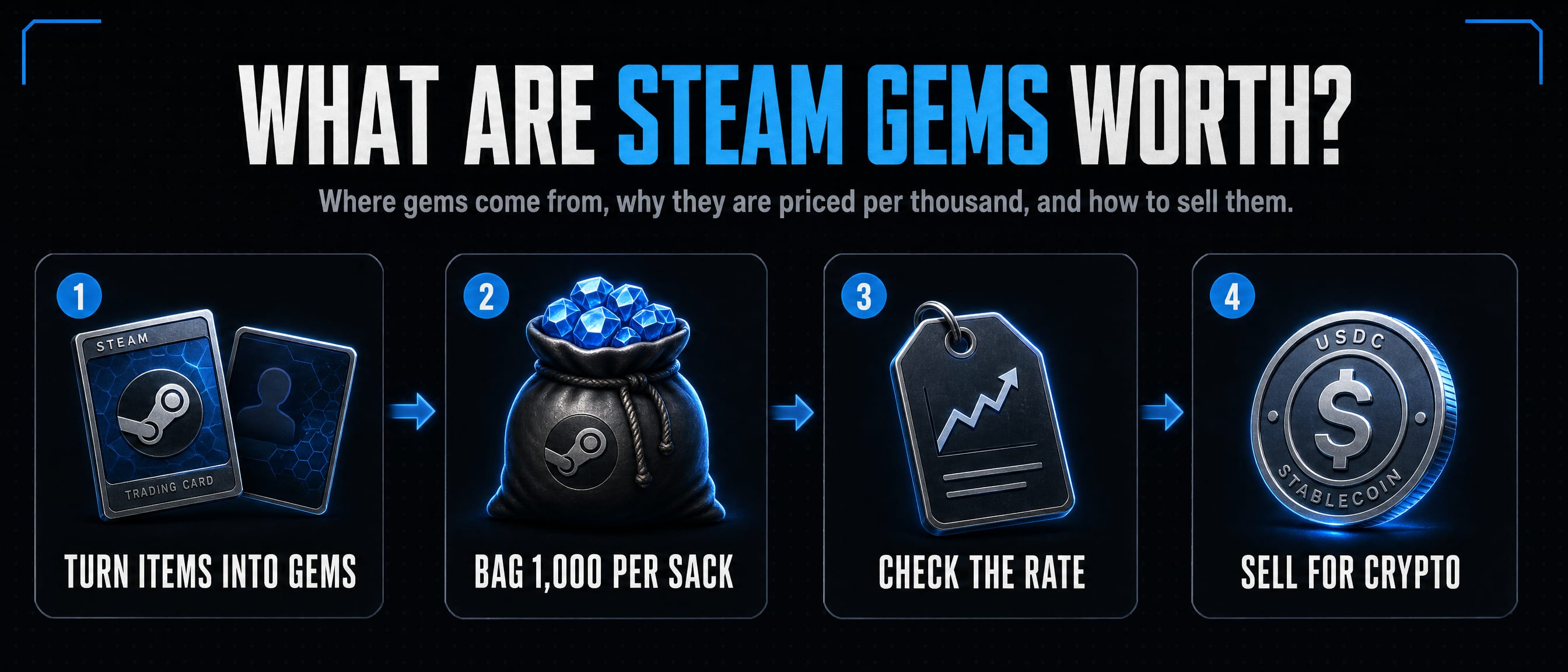
Gems are made by destroying something else. Any spare trading card, profile background or emoticon in your inventory can be turned into gems from the item's own menu, and what you get back depends on the item's rarity rather than on what it would sell for.
This is one-way. An item turned into gems is gone, and gems cannot be turned back into that item. It is worth checking the market price of a background before gemming it, because the occasional one is worth considerably more as itself.
The usual reason people end up with a large pile is a long-running account with years of duplicate cards and unwanted backgrounds accumulated from badge crafting.
What gems actually do inside Steam
Their main use is buying booster packs. A booster pack is a small bundle of one game's trading cards, which you can then craft with or sell, and it costs a fixed number of gems.
That gives gems a floor and a ceiling most people never think about: a pile of gems is really a pile of future booster packs, and a booster pack is really a few cards. Follow the chain far enough and gems are priced against card prices.
Valve has also used gems for seasonal events and sale mini-games over the years, which is why demand for them tends to move in bursts rather than smoothly.
Why gems are always quoted per thousand
One gem is worth a small fraction of a cent. Quoting a single gem produces a number with four decimal places that reads like a typo, so every price you will see, ours included, is per one thousand gems.
When you compare offers, check what unit each one is using before you compare the numbers. Per thousand against per one is a difference of three orders of magnitude, and it is an easy thing to misread quickly.
The Sack of Gems, and why you need it
Loose gems in your inventory are not directly tradable or marketable. To move them you bag them into a Sack of Gems, which holds one thousand, and it is the sack that appears on the Community Market and in trade offers.
This is why a thousand is the practical minimum unit for selling gems at all, and it is another reason every price is quoted against it.
Sacks can be unpacked back into loose gems whenever you want to spend them, so bagging is not a decision you are stuck with.
Selling on the market versus selling for cash
Listing a Sack of Gems on the Steam Community Market works, and the price it fetches is public, so it is a fair reference point for what gems are worth on any given day.
What it pays you in is the problem. Market sales pay Steam Wallet funds, minus the market's fee, and Wallet funds never leave Steam. If the goal is money you can spend anywhere, the market cannot get you there no matter what price it shows.
Selling the sacks to a buyer who settles outside Steam is what converts them. That is what our gem store does in one direction, and it sells gems the other way for people who want a pile without spending days gemming their own backgrounds.
Working out what your pile is worth
Count the gems, not the sacks, then divide by a thousand to get the unit every price is quoted in. Multiply by the rate being offered and you have the figure before any network fee.
Compare that against the current Sack of Gems price on the Community Market, taking the market's fee off before you compare, and remembering that the market pays in funds you cannot withdraw. The two numbers answer different questions, and the gap between them is not the whole story.
Sources
See what your gems are worth
A flat price per thousand, in both directions, shown before you sign in.