

5 min read
TF2 key price: what sets it, and why it moves
Why a Mann Co. key trades at three different prices at once, what the in-game store price has to do with it, and how to tell a fair offer from a bad one.
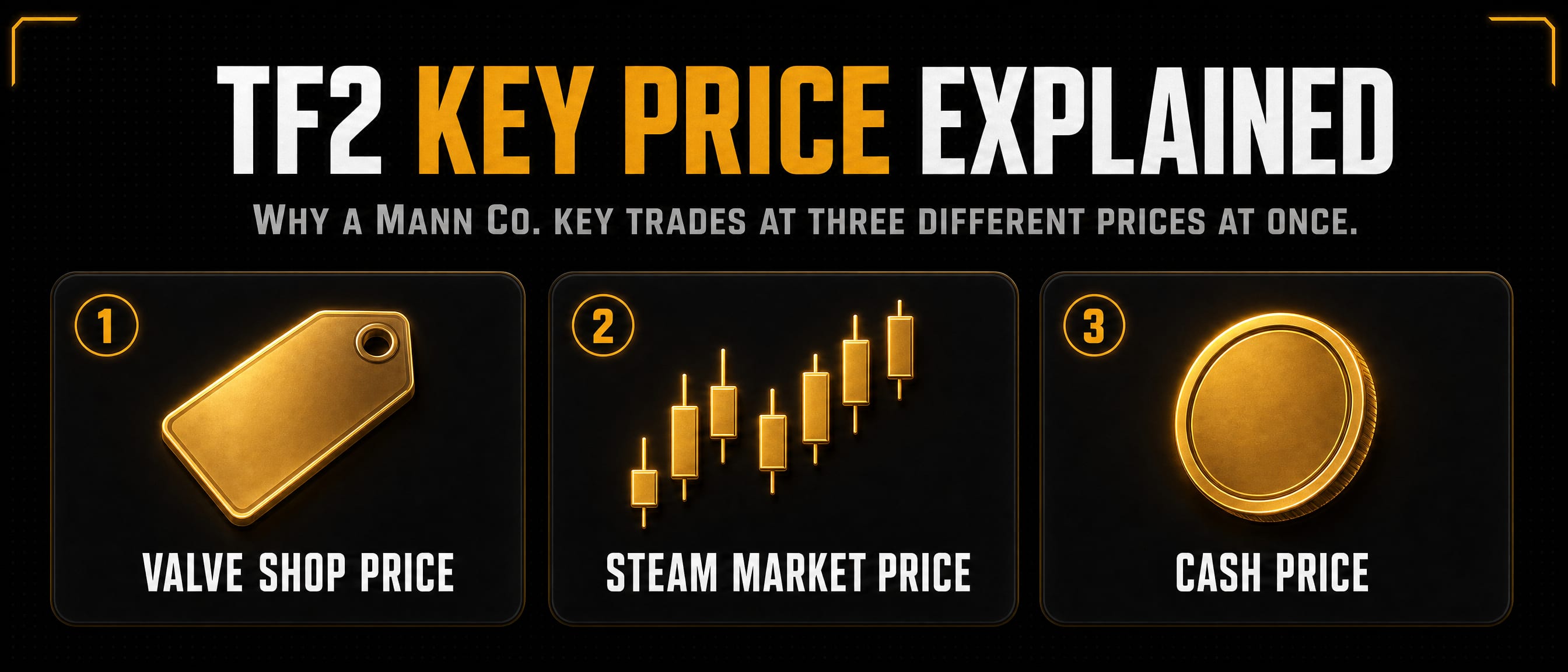
A key has three prices at once
The first is what Valve charges for a new one in the Mann Co. Store. That is a fixed shop price and it does not move with the market.
The second is what a key fetches on the Steam Community Market, paid in Steam Wallet funds with the market's fee taken out.
The third is what a key is worth in cash, outside Steam, which is what a buying desk like ours quotes. It is always below the shop price, for reasons worth understanding rather than being annoyed by.
None of these three is the real price. They are prices for three different transactions, and comparing them directly is the most common mistake in this whole subject.
Why the shop price acts as a ceiling
New keys can be bought from Valve at a fixed price and in effectively unlimited quantity. That puts a hard lid on what anyone can charge for a used one: nobody pays more for a second-hand key than for a fresh one from the shop, so the traded price sits below it and cannot climb through it.
Anything advertised above the in-game price is either not a key or not a real offer.
Why the cash price sits below the market price
A buyer paying you real money has costs a market listing does not. They carry the key until somebody buys it from them, wear the risk that the price moves in the meantime, cover the transaction fees on the way in and the payment fees on the way out, and take the loss on any trade that goes wrong.
The gap between the price a desk buys at and the price it sells at is the spread, and it is how the desk exists at all. A desk with no spread is either about to close or is not actually paying out.
What matters when you compare offers is not that a spread exists but how wide it is, and whether the same price is offered to everyone or quietly adjusted depending on how much you appear to know.
What actually moves the traded price
Supply arrives whenever people buy keys from the shop to open crates, and it never really stops. Demand comes mostly from people who want keys as a trading currency rather than to open anything.
Game updates matter more than almost anything else. A new case or a well-received cosmetic set gives people a reason to open crates, which consumes keys and firms the price. A quiet stretch does the opposite.
Anything that changes how items can be traded moves it sharply, because a key's usefulness as a currency depends entirely on being able to move it. Trade restrictions, holds and changes to how items can be exchanged all feed straight into the price.
Because of that last point, treat any specific number written in an article as history rather than as today's rate. The rate on our store page is read live; a number typed into a guide would be wrong within the week.
Telling a fair offer from a bad one
Check the buy and the sell price together. One quoted without the other tells you nothing about whether the spread is reasonable.
Check whether the price is published before you have to identify yourself. A rate that only appears after you sign in, add someone, or hand over an inventory is a rate that can be set per person.
Check what you are paid in. Steam Wallet funds and money are not interchangeable, and an offer quoting a high number in funds is not competing with a lower number in stablecoin.
Then be suspicious of anything well above the going rate, for the reason every trader learns eventually: the generous offer is the bait, and the switch happens somewhere else in the trade.
Sources
See today's key price
What we buy at and what we sell at, both on the page, the same for everyone.